What Is a QMS? Meaning, Examples and Key Parts
A plain-language answer to what a QMS is, what it contains and when a company needs one.
What is a QMS? A quality management system (QMS) is an organized framework of policies, processes, procedures, responsibilities and resources that an organization uses to consistently meet quality requirements, improve customer satisfaction and continually improve its performance.
A QMS defines how work is performed, how quality is measured, how problems are addressed and how improvements are made. It can operate using paper records, digital tools or dedicated electronic quality management system (eQMS) software. QMS stands for quality management system. Both ISO and ASQ describe it as a defined set of policies, processes and responsibilities that an organization tailors to its own work.
What Is a QMS in Simple Terms?
In simple terms, what is a QMS? It is the way an organization decides how work should be done, checks that requirements are met, deals with problems and improves its processes. It is made of people, responsibilities, processes, resources, controls and improvement activities. It is not simply a collection of documents and records.
A simple way to picture the documentation is three layers. Policies and objectives state what quality means for the organization. Processes and procedures describe how the work is done. Records and evidence show what actually happened. Together they answer three questions: what do we promise, how do we deliver it, and can we show it?
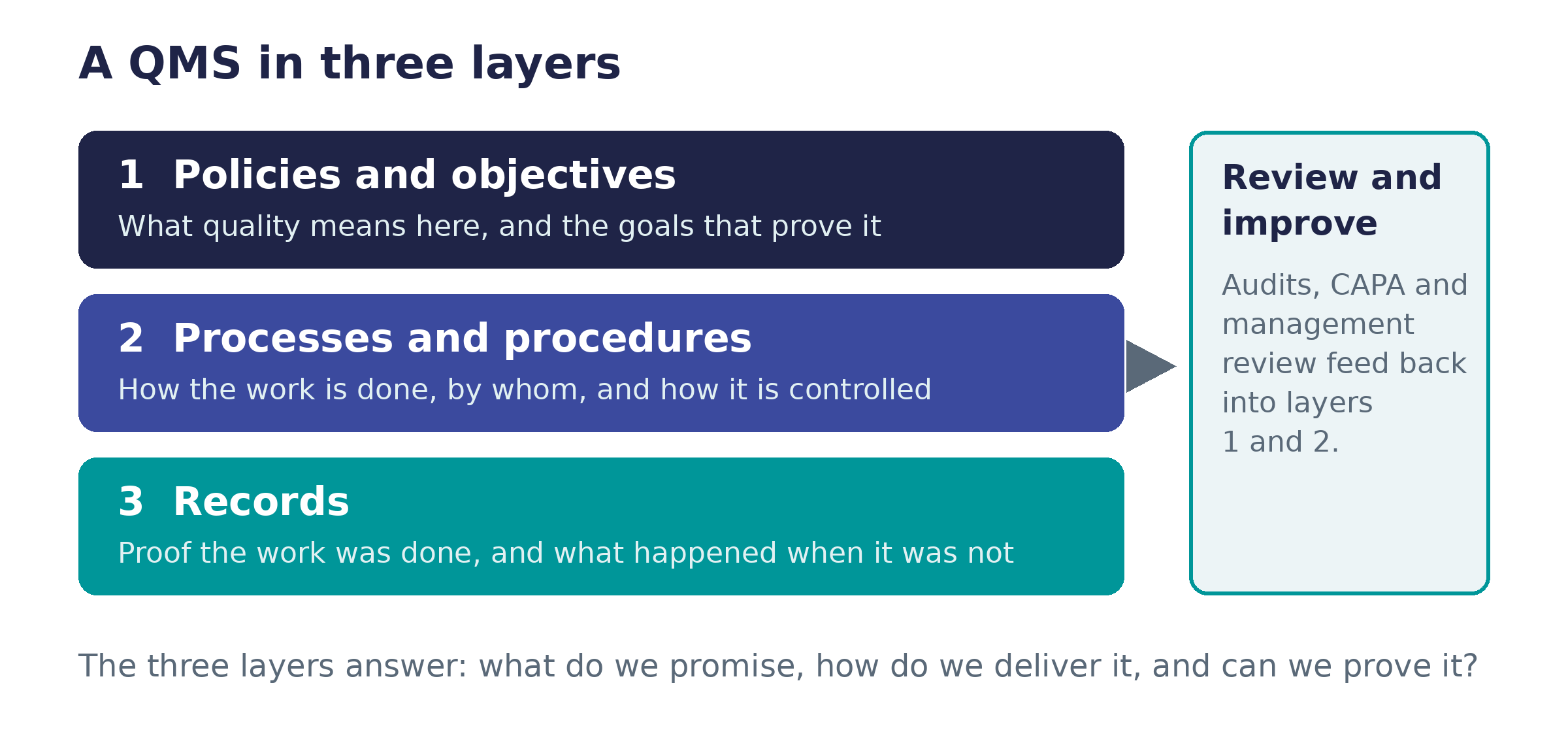
This is a simplified way to understand QMS documentation, not a full description of the whole system. People, resources, responsibilities, operational controls, performance evaluation and improvement are what connect the layers. A written procedure or a completed record does not by itself prove that a process is effective or compliant. The evidence has to show that the work meets its requirements.
What Does QMS Stand For?
QMS stands for quality management system. When the system is supported by software, it is usually called an electronic quality management system, or eQMS. The term applies to any industry, including manufacturing, aerospace, life sciences, food and services, whether or not an organization uses the name. For the formal vocabulary of quality management, ISO 9000:2026 (fifth edition, published in May 2026) is the ISO reference. For a short companion read, see QMS acronym explained.
One practical note for regulated teams: the FDA’s medical device rule still incorporates the terms in clause 3 of the earlier ISO 9000:2015, so the vocabulary you use can depend on the requirement you are working to. See the FDA QMSR page for details.
What Are the Main Components of a QMS?
What is a QMS made of? Most quality management systems share a common set of elements, although the names change from one industry and standard to the next. The table below is an illustrative framework, not a universal list of mandatory software modules, documents or regulatory records.
| Core QMS element | Purpose | Example evidence |
|---|---|---|
| Quality policy and objectives | Establish quality direction and measurable goals | Quality policy, quality objectives |
| Leadership and responsibilities | Define accountability and provide resources | Assigned process owners |
| Process management | Define how processes operate and interact | Process maps, work instructions |
| Risk and opportunity management | Identify and address conditions affecting quality | Risk assessments, action plans |
| Document and record control | Maintain current instructions and reliable evidence | Approved SOP, inspection record |
| Training and competence | Ensure personnel can perform assigned work | Training records, competency assessments |
| Operational quality controls | Verify that products or services meet requirements | Inspection and test results |
| Nonconformance and corrective action | Address problems and prevent recurrence where appropriate | NCR, CAPA record |
| Supplier management | Control externally provided products and services | Supplier evaluation records |
| Change control | Evaluate and manage changes affecting quality | Change request, approval record |
| Performance measurement | Evaluate process and QMS effectiveness | Quality metrics dashboard |
| Audits and management review | Evaluate the system and determine improvements | Audit findings, review minutes |
The exact structure depends on the organization’s size, processes, risks, applicable standards and regulatory requirements. A small service company will not need the same set of procedures as a medical device manufacturer, and no organization needs a quality manual, a standalone risk register or a specific CAPA form unless a requirement that applies to it calls for one. For a deeper look at how the pieces fit together, see the QMS structure guide.
It helps to separate two kinds of controlled information. Documents, such as an SOP or work instruction, tell people how to work and are revised over time. Records, such as an inspection result or a signed training record, show what happened and are kept as evidence. Document control manages the first kind and record control manages the second.
How Does a Quality Management System Work?
What is a QMS doing from day to day? It works as a continuing management cycle, commonly described as Plan-Do-Check-Act (PDCA). It is not a one-time documentation exercise. The Plan-Do-Check-Act guide covers the cycle in more depth.
- Plan: establish objectives, identify applicable requirements, assess risks and define processes.
- Do: provide resources, train personnel, implement processes and maintain records.
- Check: monitor performance, evaluate conformity, conduct audits and review results.
- Act: address problems, implement improvements and verify that they worked.

What Is a QMS Used For?
What is a QMS used for? Its purpose is to help an organization consistently meet quality requirements, improve customer satisfaction and keep improving its performance. When it is implemented and maintained effectively, it is intended to deliver benefits such as these:
- Consistent products and services: different people and sites do the same work the same way.
- Clear responsibilities: everyone knows who owns which process and decision.
- Reliable evidence and traceability: auditors, customers and regulators can see what was done and why.
- Fewer recurring quality problems: causes are investigated, not only symptoms.
- Trained, competent people: staff learn from controlled procedures and tracked training.
- Better management decisions: leaders review data instead of anecdotes.
- Improved customer satisfaction: requirements are met more predictably.
- Continual improvement: lessons from audits, complaints and results feed back into the system.
These are intended benefits, not guaranteed outcomes. A QMS also does not have to live in one place. Many organizations operate it across several controlled systems, such as a document repository, a training system and a records database, as long as the connections between them are controlled.
Who Needs a QMS?
What is a QMS requirement, and what is simply good practice? Organizations of any size or sector can benefit from a QMS, and ISO 9001 is written to apply that broadly. Whether one is required is a different question. Four kinds of requirement are easy to confuse:
- Voluntary management system standards, such as ISO 9001, which an organization chooses to follow.
- Third-party certification, where an independent body audits against a standard.
- Customer or contractual requirements, where a buyer asks suppliers to work to a standard or show a working QMS.
- Legally enforceable regulations, such as FDA requirements for device or drug manufacturers.
The table shows the standards and regulations most commonly associated with each industry. It is a starting point, not a statement that every organization in an industry is subject to identical requirements. Applicability depends on the product, the market, the customer and the contract.
| Industry | Common standard or regulation |
|---|---|
| General manufacturing and services | ISO 9001, plus customer requirements |
| Medical devices | ISO 13485:2016 and the applicable FDA QMSR requirements |
| Pharmaceuticals | Applicable current good manufacturing practice (cGMP) regulations, such as 21 CFR Part 211, and ICH Q10 |
| Biotechnology | Applicable GMP regulations for the product type, and ICH Q10 where adopted |
| CDMO and CRO | Requirements follow the sponsor’s product and the services provided, with responsibilities set out in quality agreements |
| Aerospace | AS9100D or the applicable successor edition |
| Automotive | IATF 16949 |
| Oil and gas | ISO 9001 and API Specification Q1 or Q2 where applicable |
| Food and beverage | Applicable food safety regulations, including Food Safety Modernization Act (FSMA) preventive controls and GFSI-recognized schemes, and ISO 22000:2018 where adopted |
| Cannabis and hemp | Requirements vary by state, so the state rules that apply to the operation govern |
ISO 9001
Many people asking what is a QMS are really asking about ISO 9001. ISO 9001:2026 is the current published edition of the standard that specifies requirements for a QMS. ISO notes it builds on the 2015 edition rather than introducing major new requirements. Organizations certified to ISO 9001:2015 should confirm the transition timeline with their certification body. Our ISO 9001:2026 guide covers the changes.
Medical device QMSR
For medical devices, the FDA’s Quality Management System Regulation (QMSR) took effect on February 2, 2026. It amends 21 CFR Part 820 and incorporates ISO 13485:2016 by reference for manufacturers subject to the applicable requirements. Holding an ISO 13485 certificate does not by itself establish FDA compliance. See the FDA’s FDA QMSR page for the rule.
Other industries
What is a QMS in the other industries? Pharmaceutical, biotechnology, CDMO and CRO, aerospace, automotive, oil and gas, food, cannabis and general manufacturing organizations each work to their own mix of standards, regulations and customer requirements. Follow the industry links in the table for page-level detail, or read the complete guide to quality management systems.
Quality Management System Examples
What is a QMS like in practice? These short examples show how a working QMS manages problems, decisions, actions and evidence in different settings. They are illustrative, not required procedures.
- Manufacturing: incoming inspection finds out-of-tolerance parts. The lot is quarantined, a nonconformance is recorded, and the supplier may be asked for a corrective action depending on the cause and the supply agreement.
- Life sciences: a deviation is recorded during production. It is investigated, a CAPA is raised if the investigation supports one, and an effectiveness check confirms the fix held.
- Services: a customer complaint is logged, the contributing causes are traced to a process step, and the procedure is revised through document control and communicated to the team.
A connected example
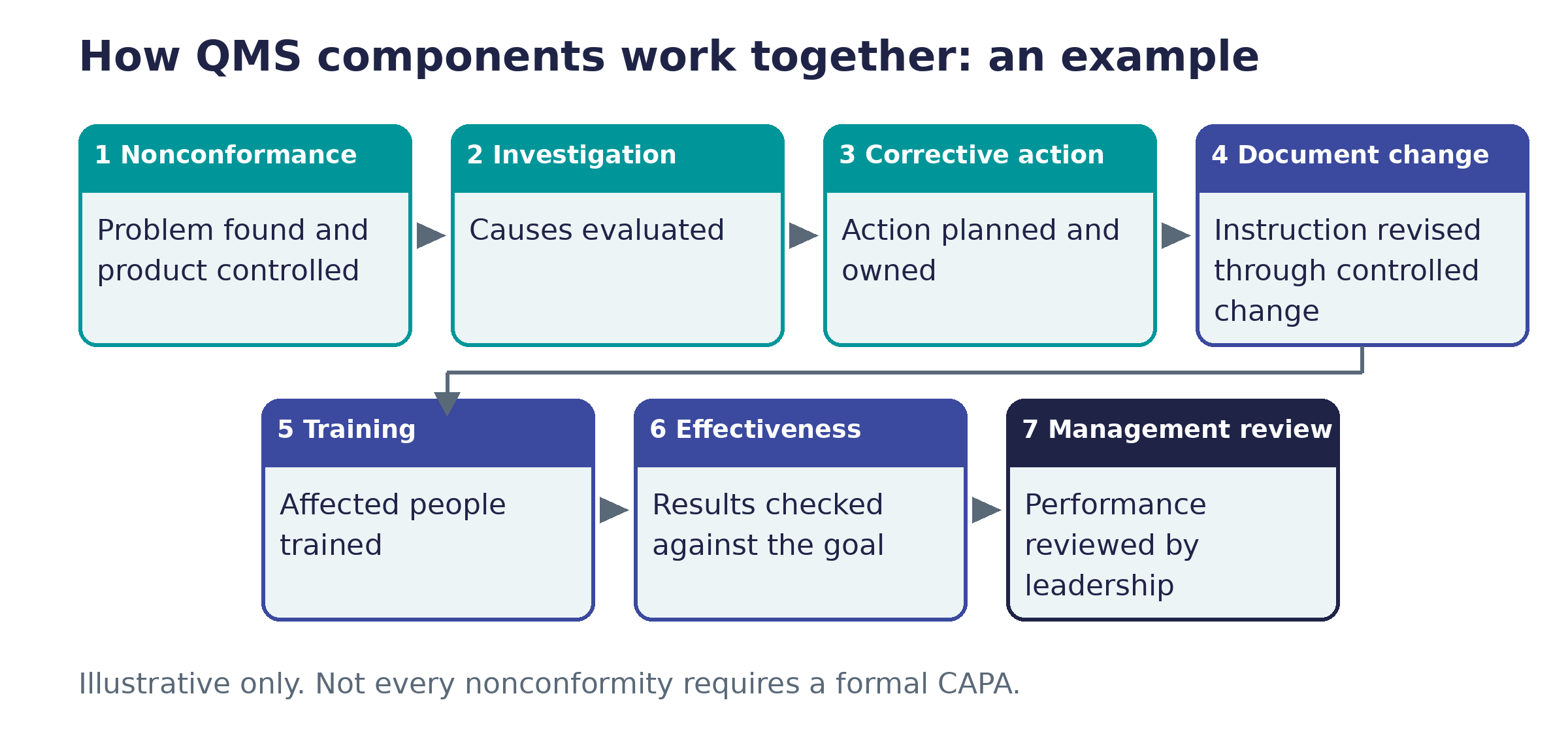
The example below shows how several parts of a QMS connect. It is an illustration, and your own procedures define the actual steps. In particular, not every nonconformity requires a formal corrective action or the same investigation workflow.
A manufacturer finds a recurring product defect during inspection. The affected product is identified and controlled, and a nonconformance is recorded. The quality team evaluates the issue and decides that a formal corrective action is appropriate. An investigation finds that an inadequate work instruction is a contributing cause. The instruction is revised through document control and change control, affected personnel are trained, and later inspection results are monitored. The quality team then verifies whether the corrective action achieved its intended outcome and presents the relevant quality performance results at management review.
Common QMS Terms
Which terms come up most often? These short definitions are paraphrased for plain-language use. The formal wording sits in ISO 9000, and the terms can vary slightly between standards and regulations.
- SOP: a standard operating procedure defining how an activity or process is performed.
- Nonconformity: nonfulfillment of a requirement.
- Deviation: a departure from an established procedure, specification or expected condition, as defined by the applicable quality system.
- Correction: action to address an identified nonconformity.
- Corrective action: action to address the cause of an identified nonconformity and prevent recurrence.
- Preventive action: action to address the cause of a potential nonconformity and prevent occurrence.
- CAPA: corrective and preventive action, a structured approach to managing those actions where applicable. See the CAPA definition.
- Root cause: an underlying cause that contributes to the occurrence of a problem.
- Effectiveness check: an evaluation of whether an implemented action achieved its intended outcome.
- Management review: a formal evaluation of QMS performance and suitability by top management.
Not every problem has a single root cause. Many have several contributing causes, and an investigation should follow the evidence. ISO 9001 builds preventive thinking into risk-based planning rather than requiring a separate preventive action procedure, although regulated industries often keep CAPA as the term for their combined corrective and preventive action process.
QMS vs. Quality Assurance and Quality Control
QA and QC are parts of quality management and often operate within the broader QMS. The QMS is the whole system, so what is a QMS compared with QA and QC? It is the container for both. Quality assurance (QA) builds confidence that quality requirements will be fulfilled, and quality control (QC) focuses on fulfilling them. Neither term is only about prevention or only about detecting defects. For more depth, see quality assurance vs. quality control.
| Area | QMS | Quality assurance (QA) | Quality control (QC) |
|---|---|---|---|
| Scope | Entire quality management system | Confidence that quality requirements will be fulfilled | Fulfillment of quality requirements |
| Focus | Managing and improving quality | Processes and assurance activities | Operational controls and verification |
| Examples | Quality policy, risk management, training and improvement | Process qualification, procedure reviews and audits | Inspection, testing and process monitoring |
What Is the Difference Between a QMS and an eQMS?
What is a QMS, and what is an eQMS? A QMS is the management system itself. An electronic quality management system (eQMS) is software that supports the operation and control of quality management processes. Buying software does not by itself create an effective or compliant QMS. The organization still has to define, implement, maintain and evaluate its quality processes.
Paper and spreadsheets cost little to start, and a QMS does not require software. Electronic systems are not universally required. The table compares how common capabilities are usually handled, and what an eQMS can offer depends on the software, its configuration and its intended use.
| Capability | Paper-based QMS | Spreadsheet-based QMS | Integrated eQMS |
|---|---|---|---|
| Document revision control | Manual | Typically manual | Controlled workflows, where configured |
| Approvals | Handwritten signatures | Email or separate records | Electronic approval workflows, where configured |
| Record retrieval | Physical search | File and folder search | Centralized search |
| Training traceability | Separate records | Manually maintained | Connected where supported |
| CAPA tracking | Manual registers | Tracking spreadsheets | Structured workflows |
| Management reporting | Manual compilation | Spreadsheet reporting | System reporting |
| Audit trails | Manual evidence | Tool-dependent | Configurable electronic records |
Not every eQMS includes compliant electronic signatures, complete audit trails, automatic training assignments or validated workflows, so check these against your own requirements. The guide to eQMS software explains what to look for.
How to Establish a Quality Management System
What is a QMS you can realistically set up? There is no single required sequence, but most organizations work through the same steps. Treat this as a starting outline, and note that certification is optional unless a customer or regulator requires it.
- Identify applicable requirements and define the QMS scope.
- Establish quality policies, objectives and responsibilities.
- Identify processes and their interactions.
- Assess risks and establish operational controls.
- Document procedures and define required records.
- Train personnel and evaluate competence.
- Monitor quality performance and investigate problems.
- Conduct internal audits and management reviews.
- Implement and verify improvements.
The complete guide to quality management systems covers implementation in detail.
How to Tell Whether Your QMS Is Working
What is a QMS expected to deliver? A QMS is working when the evidence shows intended results, not simply when procedures are approved and records are complete. Useful evidence includes:
- Achievement of quality objectives.
- Product and service conformity.
- Customer complaints and satisfaction.
- CAPA effectiveness and recurrence.
- Supplier performance.
- Training compliance and competency.
- Audit findings and verified follow-up.
- Process performance.
Two distinctions matter. Closing a corrective action is not the same as showing it was effective, which requires evidence that the problem did not return. Likewise, completing training is not the same as being competent, which needs an assessment of whether people can do the work. Choose metrics according to your risks, applicable requirements and quality objectives. For formulas and worked examples, see our quality metrics with formulas and worked examples.
Common QMS Mistakes
Where does a QMS most often go wrong? These are the mistakes that come up most.
- Writing procedures that do not reflect actual work. If the procedure and the practice differ, evaluate the gap and resolve it through the appropriate quality processes, for example by revising the procedure through document and change control or by correcting the practice. Do not informally change an approved procedure to match unauthorized practice.
- Treating quality as the quality department’s job alone. Every team owns its processes and records.
- Focusing on symptoms. Investigate causes where appropriate, so the same problem does not return.
- Measuring activity instead of effectiveness. Counting tasks done says little about results.
- Treating training completion as proof of competence.
- Collecting data without assigning follow-up actions. Data that no one reviews does not improve anything.
- Pursuing certification without maintaining an effective system. The goal is a system that works, not only one that passes an audit.
- Assuming QMS software alone establishes compliance. Software supports a QMS but does not replace one.
How eLeaP Supports Quality Management
What is a QMS like inside eLeaP? eLeaP combines quality management with enterprise learning management. Quality teams can manage controlled documents, nonconformances, corrective actions, audits, suppliers, risks and changes alongside the training records that support those processes. For example, when a controlled procedure changes, the approved document can be sent to the eLeaP learning management system (LMS) to create a course. This helps connect approved quality requirements with evidence that affected employees received the relevant training. The table maps common QMS elements to the matching areas of eLeaP QMS software, as described in the product documentation.
| QMS element | eLeaP area | What it does |
|---|---|---|
| Document and record control | Documents | Moves each document through a lifecycle (for example Draft, In Review, Pending Approval, Approved, Effective and Obsolete). Reviewers and approvers act on it, approvers sign electronically, and printed or downloaded copies are watermarked as controlled copies. |
| Training and competence | Training and the LMS | Approved or Effective documents can be sent to the LMS to create a course, either a standard course or an observation checklist. The document then shows training statistics for its linked course. |
| Nonconformance and corrective action | Events | Records quality events, investigation (contributing factors, root cause methods and actions) and an effectiveness check with defined criteria and a target metric. See also nonconformance management. |
| Internal and supplier audits | Audits | Plans internal and supplier audits, assigns a checklist template, records the standards and clauses in scope and the findings, and links corrective actions to findings. |
| Supplier management | Suppliers | Keeps supplier records with type, risk level, qualification activities and an approval workflow. |
| Risk management | Risk | Scores risks with configurable probability and severity scales, with an optional ISO 14971 scoring model. |
| FMEA | Risk, FMEA worksheet | Shows a project’s risk items as a Failure Mode and Effects Analysis worksheet when FMEA is switched on for the project. |
| Change control | Change Control | Uses a Change Request to define what needs to change and why, and a Change Order to control how and when the approved change is implemented. |
| Design and development controls | Design and Development | Links user needs, design inputs, design outputs, verifications and validations for traceability, includes design reviews, and exports a traceability matrix. |
| Meetings and management review | Events, Meetings | Records management reviews, quality reviews and design reviews with attendees and a Scheduled, Held or Signed Off status. |
| Equipment and calibration | Events, Equipment | Keeps a register of measuring and test equipment, records each calibration with As Found and As Left readings, routes it for approval, and lets a team raise an event when a result is out of tolerance. |
Capabilities depend on how your company’s account is configured. The table describes functions in the current product documentation and is not a guarantee of any compliance outcome.
See how eLeaP connects quality management and employee training in one platform: visit the eLeaP QMS software page. If you are starting from scratch, the complete guide to quality management systems is a good companion read.
Frequently Asked Questions About What Is a QMS
What does QMS stand for? QMS stands for Quality Management System. It is an organized framework of processes, responsibilities, policies and resources used to manage and improve quality.
What is a QMS in simple terms? A QMS is the way an organization defines how work should be performed, checks whether requirements are met, addresses problems and improves its processes.
What is the main purpose of a QMS? The main purpose of a QMS is to help an organization consistently meet quality requirements, improve customer satisfaction and continually improve performance.
What are the main components of a QMS? Common components include quality policies and objectives, process management, document control, training and competence, risk management, operational controls, corrective action, performance measurement, audits and management review.
What is an example of a QMS? A manufacturing QMS may include approved work instructions, employee training, incoming inspection, equipment calibration, nonconformance reporting, corrective actions and management review.
Is a QMS the same as ISO 9001? No. A QMS is the organization’s quality management system. ISO 9001 is a standard that specifies requirements for a QMS. Organizations can operate a QMS without pursuing ISO 9001 certification.
What is the difference between a QMS and an eQMS? A QMS is the management system itself. An eQMS is electronic software used to support the operation, control and monitoring of quality management processes.
Does every company need a QMS? Not every organization is legally required to maintain a formal QMS, but organizations can benefit from systematic quality management. Regulatory, certification and customer requirements vary by industry and organization.
Can a small business have a QMS? Yes. A small business can establish a QMS appropriate to its size, processes, risks and applicable requirements. A QMS does not need to be unnecessarily complex.
Does a QMS require software? No. A QMS can operate using paper-based processes, digital records or dedicated software, subject to applicable requirements. Software can support efficiency, traceability and controlled workflows but does not replace an effective management system.
What is a QMS in manufacturing? In manufacturing, a QMS is the set of controlled procedures, training, inspection, equipment calibration, nonconformance reporting, corrective action and management review that keeps production meeting its requirements.
How do you know whether a QMS is effective? Evaluate achievement of quality objectives, product and service conformity, customer feedback, process performance, audit results and corrective action effectiveness.