What Is a Quality Management System? How It Works
How a quality management system works day to day, with the ISO 9001 principles and a worked example.
What is a quality management system? A quality management system (QMS) is a structured framework of policies, processes, responsibilities, procedures and records that an organization uses to consistently meet customer and applicable regulatory requirements. It establishes how quality is planned, controlled, measured and improved.
In practice, a QMS connects the people performing the work, the procedures they follow, the records they create and the decisions made when something goes wrong. This guide explains how those elements work together through the Plan-Do-Check-Act cycle, the quality management principles and a worked example.
Key Takeaways
- A QMS establishes how quality is managed, controlled and demonstrated.
- ISO 9001 provides a recognized framework for quality management, but certification is not necessary to operate a QMS.
- A working QMS connects processes, responsibilities, documentation, competence and improvement.
- Quality records provide evidence that the system operates as intended.
- An electronic QMS supports the execution and documentation of quality processes.
What Is a Quality Management System?
An effective quality management system has operating characteristics that distinguish it from a collection of procedures. Responsibilities are assigned to named owners. Documents are controlled so people use the current version. Work leaves records that can be checked later. When something goes wrong, a defined process decides what happens next, and leadership reviews the results. For the full framework, standards and implementation steps, see the complete guide to quality management systems. For a short definition and the parts of a system, start with what is a QMS.
How a Quality Management System Works
ISO 9001 uses a process-based approach to quality management supported by the Plan-Do-Check-Act (PDCA) cycle and risk-based thinking. The cycle helps organizations establish controls, carry out planned activities, evaluate results and make improvements. Its requirements sit in clauses 4 to 10, which are commonly grouped around that cycle.
| PDCA stage | What the organization does | Example evidence |
|---|---|---|
| Plan | Establish processes, objectives, responsibilities and controls | Quality objectives, risk assessments, process maps |
| Do | Perform activities using approved procedures and competent personnel | Inspection results, production records, training records |
| Check | Monitor performance, conduct audits and review outcomes | Quality metrics, audit findings, management review records |
| Act | Address problems and improve processes | Corrective actions, approved changes, effectiveness checks |
PDCA is a recurring management cycle, not a one-time implementation exercise. Each pass uses what the Check stage found to improve the next Plan.
What Is a Quality Management System Used For?
A quality management system is used to make results repeatable and provable. It helps an organization show customers and regulators that requirements are met, find problems earlier and check whether corrective actions worked. It also gives leadership a regular view of performance through management review, so decisions rest on records instead of recollection.
The Seven Principles of Quality Management
ISO describes seven quality management principles, set out in the ISO 9000 vocabulary standard, and ISO 9001 builds its requirements on them. They explain the reasoning behind the clauses. Each is shown below with a practical example.
- Customer focus: understand needs and measure whether you meet them. Example: evaluate complaints and feedback against customer requirements.
- Leadership: leaders set direction and take responsibility for the system. Example: allocate resources and assign accountability through management review.
- Engagement of people: competent, involved people make the system work. Example: establish and verify role-based competence.
- Process approach: manage activities as connected processes, not isolated tasks. Example: connect purchasing, incoming inspection, production and release controls.
- Improvement: keep finding and fixing weaknesses. Example: investigate recurring problems and evaluate corrective action effectiveness.
- Evidence-based decision making: decide from data and records, not opinion. Example: use inspection results, audit findings and quality trends.
- Relationship management: manage suppliers and partners that affect your results. Example: evaluate suppliers and other relevant partners against defined requirements.
ISO 9001:2015 Clauses 4 to 10 in Plain Language
ISO published ISO 9001:2026, the sixth edition, on September 16, 2026, and it replaces ISO 9001:2015. The table below summarizes the 2015 edition because organizations certified to ISO 9001:2015 may continue working under that edition during the certification transition. ISO says the 2026 edition retains the Harmonized Structure used across ISO management system standards, and it highlights changes to leadership (clause 5.1), the quality policy (5.2), risks and opportunities (6.1) and awareness (7.3), plus a new Annex A of explanatory guidance.
DNV and LRQA report that ISO 9001:2015 certificates cease to be valid after September 30, 2029, under transition requirements published by Global ACI, the international accreditation authority. Organizations should confirm their applicable transition milestones with their certification body and refer to current accreditation and certification transition guidance. Check clause wording against the edition you are working to.
| Clause | Title | What it means in practice |
|---|---|---|
| 4 | Context of the organization | Know who your customers and stakeholders are, and define the scope of the system |
| 5 | Leadership | Top management owns the system, sets the policy and assigns responsibilities |
| 6 | Planning | Plan for risks and opportunities and set measurable quality objectives |
| 7 | Support | Provide people, training, infrastructure and controlled documented information |
| 8 | Operation | Plan and control how products and services are designed, bought, made and delivered |
| 9 | Performance evaluation | Monitor, measure, audit and review the system, including customer feedback |
| 10 | Improvement | Handle nonconformities, take corrective action and keep improving |
A Worked Example: One Failed Delivery
The clearest way to see how a quality management system works is to follow one problem through it. The example below is illustrative. Your own procedures define the exact steps and owners.
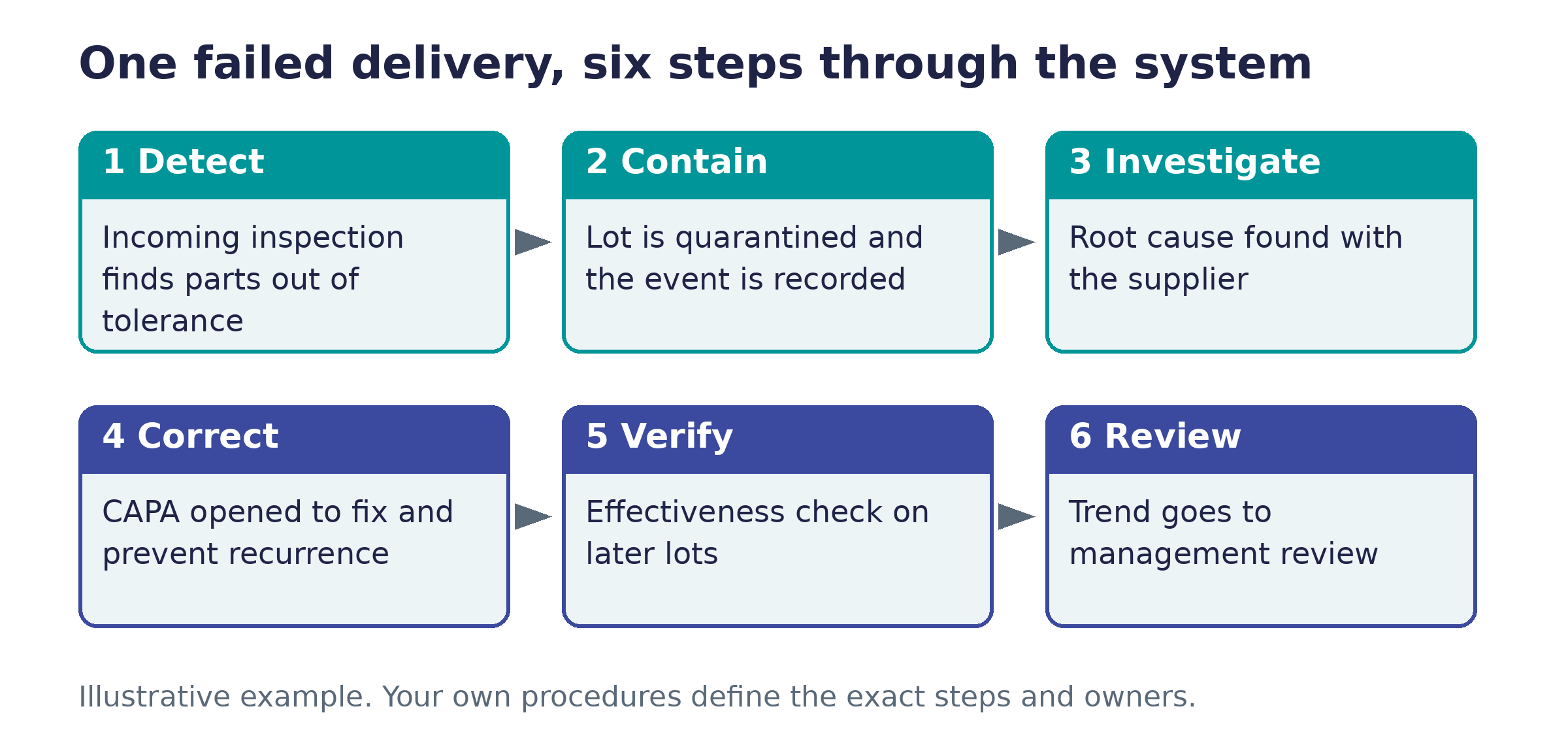
- Detect: incoming inspection finds parts out of tolerance and records the result.
- Contain: the lot is quarantined so it cannot be used, and a nonconformance is opened.
- Investigate: the team and the supplier work to identify the root cause.
- Correct: the organization addresses the detected nonconformity and, where warranted, initiates corrective action to address its root cause and prevent recurrence. Affected procedures and training are updated as appropriate.
- Verify: subsequent inspection results and other relevant evidence are evaluated against defined effectiveness criteria.
- Review: the trend reaches management review, which decides whether more action is needed.
Not every nonconformance requires a formal CAPA. The decision depends on applicable requirements, risk, severity, recurrence and organizational procedures. A correction addresses the detected problem, while corrective action addresses its cause to prevent recurrence. Effectiveness verification evaluates whether the action achieved its intended result.
Every step leaves a record. That is what separates a quality management system from good intentions: someone can open the records months later and see what happened, who decided, and whether it worked. In an integrated electronic QMS, related records can be linked to maintain a retrievable history of the event, investigation and resulting actions. See how quality events, CAPA management and document lifecycle management connect.
What Would an Auditor Expect to See?
When a quality event results in a procedure revision, relevant evidence may include:
- Original quality event record.
- Investigation and resulting decisions.
- Approved document revision.
- Approval history and effective date.
- Applicable training or competence records.
- Effectiveness verification results.
Specific evidence requirements depend on applicable standards, regulations and organizational procedures.
How a Quality Management System Works in eLeaP QMS
In eLeaP QMS, the failed-delivery example runs through connected modules instead of separate files. The list follows the capabilities in the eLeaP QMS user guide.
- Detect and contain: an event is opened from a template, scored for risk by probability and severity, and tagged with contributing factors such as people, process, equipment, material, environment and measurement.
- Investigate: root cause analysis methods include 5-Why, Fishbone, Fault Tree, Failure Mode Analysis and Kepner-Tregoe.
- Correct: corrective, preventive and containment actions move from Open to Verified, with evidence attached.
- Verify: an effectiveness check has an owner, a scheduled date and a recorded outcome. An AI Health Check scores an event from 0 to 100. The AI Health Check provides a software-generated review aid. Its score does not establish regulatory compliance, replace quality approval or determine corrective action effectiveness.
- Review: the Events Summary shows overdue CAPAs, average close time and recurring root causes, and the Meetings area records the management review and its sign-off.
Two more capabilities extend the same example. In Audits, findings are classed as major nonconformance, minor nonconformance, observation or opportunity for improvement, and each finding can raise a corrective action linked to an event. In Equipment and Calibration, an out-of-tolerance calibration result can raise an event directly. See audit management software and management review software for more.
Connecting Quality Events, Documents and Training
A corrective action may require a procedure to be revised and affected personnel to be trained on the updated requirements. By combining quality management, document control and enterprise learning management, eLeaP helps organizations maintain evidence of the quality decision, the approved procedural change and the associated training activities.
An illustrative workflow: Quality event → Investigation → Corrective action → Controlled document revision → Personnel training → Effectiveness verification → Management review.
This sequence is illustrative, not an automatic chain. The organization decides when a corrective action calls for a revision or for training. In eLeaP QMS, approved or effective documents can be sent to training in the connected eLeaP LMS, one at a time or in bulk, and an administrator can enable a document setting that sends a document to training when it is approved. An event can also be linked to the related training record in the LMS. See how controlled document management and training management work together.
Quality Management Systems Across Industries
The principles stay the same across industries. What changes is the standard, regulation or customer requirement layered on top. The entries below are summaries, so confirm the requirements that apply to your products, activities and markets.
- General manufacturing and services: ISO 9001 is a widely used framework, and many sector standards build on it. For service organizations, the operation clause looks different from manufacturing, but the requirements apply in the same spirit.
- Medical devices: the QMSR took effect on February 2, 2026 and incorporates ISO 13485:2016 by reference while retaining additional FDA requirements, as FDA’s QMSR page explains. ISO 13485 certification alone does not establish FDA compliance.
- Pharmaceuticals: current good manufacturing practice (CGMP) regulations apply, including 21 CFR Part 210 and Part 211. 21 CFR 211.192 is one specific example: it covers production record review and the investigation of unexplained discrepancies and failed batches.
- Biotechnology: ICH Q10 describes a pharmaceutical quality system model that includes process performance and product quality monitoring and a CAPA system. How it applies depends on the product, development stage, regulated activities and jurisdiction, and it is intended to be used alongside regional GMP requirements.
- CDMO and CRO: a CDMO’s manufacturing quality requirements, such as CGMP and the written quality agreement FDA recommends between an owner and its contract facility, differ from the requirements for a CRO’s work. Clinical research follows good clinical practice such as ICH E6(R3), nonclinical laboratory studies follow 21 CFR Part 58, and other GxP requirements depend on the services provided.
- Oil and gas: API Spec Q1 sets quality management system requirements for organizations providing products for the petroleum and natural gas industry, aligned with ISO 9001:2015. API Spec Q2 addresses service supply organizations, and its third edition, published in September 2026, focuses on well-site services. Obligations may arise from API certification, customer contracts or applicable regulations.
- Food and beverage: 21 CFR Part 117 requires covered facilities to prepare and implement a written food safety plan, including a hazard analysis and preventive controls, but exemptions and modified requirements apply, such as those for qualified facilities. Certification programs such as FSSC 22000, BRCGS and SQF are GFSI-recognized private schemes, not FDA regulations, although customers may require them.
- Cannabis and hemp: the frameworks differ. Hemp production falls under USDA’s Domestic Hemp Production Program (7 CFR Part 990), while FDA regulates cannabis and cannabis-derived products that fall under its authority. Cannabis businesses licensed by states follow state and local rules that vary, so check your licensing authority.
- Automotive: IATF 16949:2016 is the automotive standard published by the IATF, which keeps it aligned with ISO 9001 and is used with it. Confirm the edition your customers require.
- Aerospace: AS9100D includes the ISO 9001:2015 requirements and adds aviation, space and defense requirements.
A new ISO 9001 edition does not automatically revise sector-specific standards. Each standards body publishes its own editions and transition rules, so confirm the edition and dates that apply with your customers and certification body.
Building a Quality Management System: First Steps
Start by identifying the statutory, regulatory, customer and contractual requirements that apply to your products and services, because they shape the scope of your system. You do not need to build everything at once. Most teams then work through six moves and refine as the system matures. The complete guide covers implementation in depth.
- Define the scope of the system and write the quality policy.
- Set a few measurable quality objectives.
- Map the key processes and name an owner for each.
- Control the approval, revision, distribution and retention of documented information so personnel use applicable current procedures and historical records remain available where required.
- Train affected personnel on applicable procedures, evaluate competence as appropriate and retain relevant evidence.
- Run internal audits and a management review, then act on what they find.
What a Quality Management System Is Not
- Not a certificate. ISO 9001 certification shows a system was assessed. It does not run the system for you.
- Not a binder of documents. Procedures matter only if people follow them and records prove it.
- Not one department. Top management retains accountability for the QMS, quality personnel provide coordination and oversight, and process owners manage their respective activities and records.
- Not a software purchase. An electronic QMS supports quality processes, but the organization remains responsible for implementing and maintaining its quality system.
- Not a one-time project. A QMS requires ongoing monitoring, evaluation, maintenance and improvement.
What Is the Difference Between a QMS and an eQMS?
A QMS is the organizational framework used to manage quality. An electronic quality management system (eQMS) is a software platform that supports the execution, control and documentation of that framework. An eQMS can help connect quality workflows, control documented information, track responsibilities and make evidence easier to retrieve. For a deeper comparison, read the eQMS software guide.
Signs a Quality Management System Is Healthy
A healthy system shows up in the records, not in the binder. Look for these signs, and track them with quality metrics:
- Personnel have access to applicable current approved procedures.
- Training and competence evidence aligns with procedures and responsibilities.
- Quality actions are completed within established timeframes, or delays are appropriately justified and managed.
- Corrective actions are evaluated for effectiveness.
- Recurring nonconformities are monitored and investigated as appropriate.
- Internal audit findings receive documented follow-up.
- Supplier performance is monitored against defined criteria.
- Management review produces documented decisions, assigned owners and follow-up actions.
Complaint and nonconformance trends should be interpreted in context. Increased reporting can reflect improved detection or a stronger reporting culture rather than deteriorating quality performance.
Next Steps
- Compare options in the complete guide to eQMS software.
- Choose what to measure with quality metrics.
- Building to the standard? See ISO 9001 software.
See How an Integrated Quality Management System Works
eLeaP QMS brings quality events, corrective actions, document control, risk management, audits, supplier management, management review and enterprise learning management together in one platform.
Explore how connected quality workflows, controlled documents and training evidence can support your organization’s quality management system.
Frequently Asked Questions
What is a quality management system in simple terms?
A quality management system is the organized way a company plans quality, does the work to that plan, checks the results and improves what it finds. It is made of policies, processes, procedures and records.
What is the purpose of a quality management system?
Its purpose is to deliver products or services that consistently meet customer and regulatory requirements, and to improve them over time by finding and fixing problems systematically.
How does a quality management system work?
It works as a cycle: plan the processes and controls, run the work to them, check results through monitoring, audits and review, and act on what the checks show.
Do you need ISO 9001 certification to have a quality management system?
No. You can run a quality management system without certification. ISO 9001 is a standard you can build to and have independently assessed, but it is not a condition for having a system.
What is an example of a quality management system?
A manufacturer that builds its system to ISO 9001 is a common example. It controls its procedures, trains people, inspects incoming material, records and investigates nonconformances, audits itself and reviews results in management review. The failed-delivery example above follows one problem through such a system.
What is the difference between a QMS and quality control?
Quality control covers the activities that check whether a product or service meets requirements, such as inspection and testing. A QMS is the wider framework that includes quality control and also covers policy, responsibilities, document control, training, audits, corrective action and management review. See quality assurance vs. quality control for more.
What is the difference between a QMS and an eQMS?
A QMS is the organizational framework used to manage quality. An electronic quality management system (eQMS) is a software platform that supports the execution, control and documentation of that framework.
Who is responsible for a quality management system?
Top management is accountable for the system. Quality personnel provide coordination and oversight, process owners manage their activities and records, and all personnel follow the procedures that apply to their work.
Is ISO 9001 the same as a quality management system?
No. ISO 9001 is a standard that sets requirements for a quality management system. The system itself is what an organization builds and operates, and it can be built to ISO 9001, with or without certification, or to other requirements.