Currently browsing "eQMS"
An introduction to electronic quality management systems (eQMS): what they replace, how they work, and what to look for when moving off paper-based or spreadsheet-based quality processes.
-
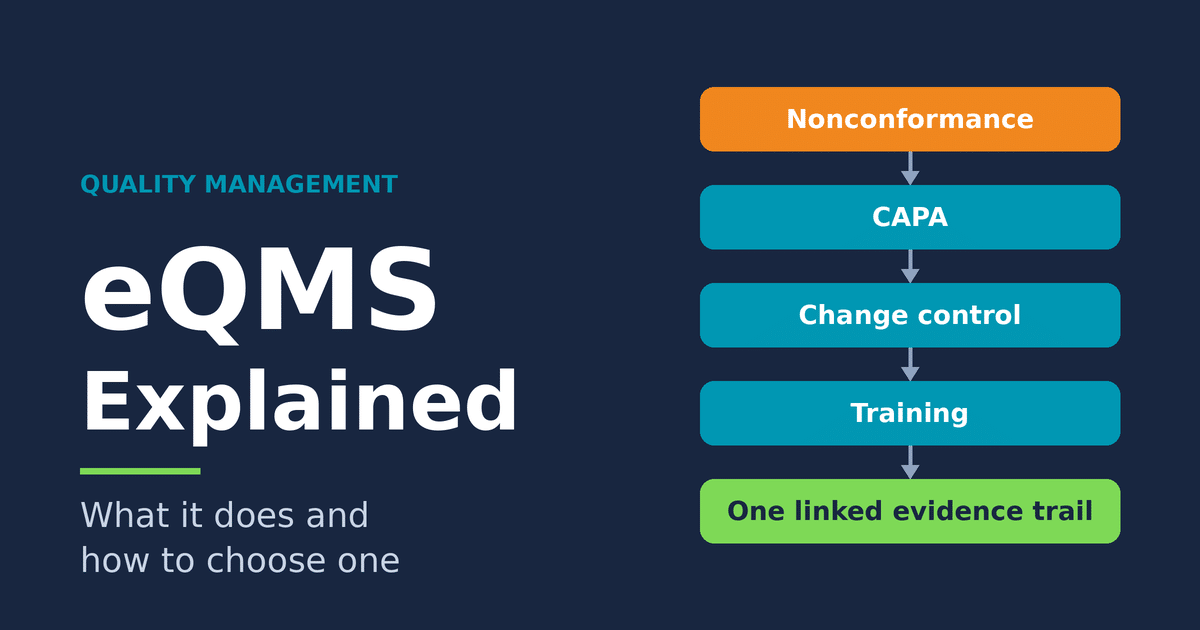
eQMS Explained: What It Does and How to Choose One


The audit-evidence test Could your team prove which procedure was in effect on a given date, who was trained on it, and why a CAPA was closed, without searching across five different places? Picture two quality offices on the same afternoon. An auditor asks each one for the current procedure, the training proof, the linked […]
-
eQMS Full Form: What Does eQMS Stand For?
eQMS stands for Electronic Quality Management System. This eQMS acronym describes a digital software solution. It replaces paper-based quality processes with automated, connected workflows. The full form of eQMS captures both its digital nature and its purpose. It exists to manage, monitor, and improve quality across an organization. Quality professionals, compliance teams, and executives use […]
-
PLM vs eQMS: Key Differences and When You Need Both
Engineers and quality leads often use PLM and eQMS interchangeably. That confusion is understandable, as both systems manage product-related data. Both touch design, documentation, and compliance. But they solve fundamentally different problems. PLM tracks how a product evolves from concept to retirement. An eQMS ensures that the product meets quality and regulatory standards throughout its […]
-
Top Advantages of an eQMS: Why Regulated Industries Are Making the Switch
Quality failures are far more expensive than most executives realise. According to the American Society for Quality (ASQ), organisations lose between 15% and 20% of total revenue to poor quality every year. That figure includes product recalls, regulatory fines, rework costs, and reputational damage. For regulated industries, the stakes are even higher. Paper-based quality management […]
-
QMS vs eQMS: Key Differences Explained (2026 Guide)
Your QMS exists. But can you prove it at 9 am on audit day? That single question separates organisations that merely have a quality management system from those that actively live by one. Quality managers across manufacturing, life sciences, and healthcare answer this question every day. Many find that their paper-based systems fall short exactly […]
-
What is an eQMS? A Complete Guide to Electronic Quality Management Systems

Quality failures cost manufacturers between 15 and 20 percent of annual revenue, according to ASQ. That is not just a production problem. It signals a systemic failure in how quality gets managed. For decades, organizations relied on paper binders, shared drives, and spreadsheets. Those tools worked until regulations tightened and operations scaled. Today, teams across […]